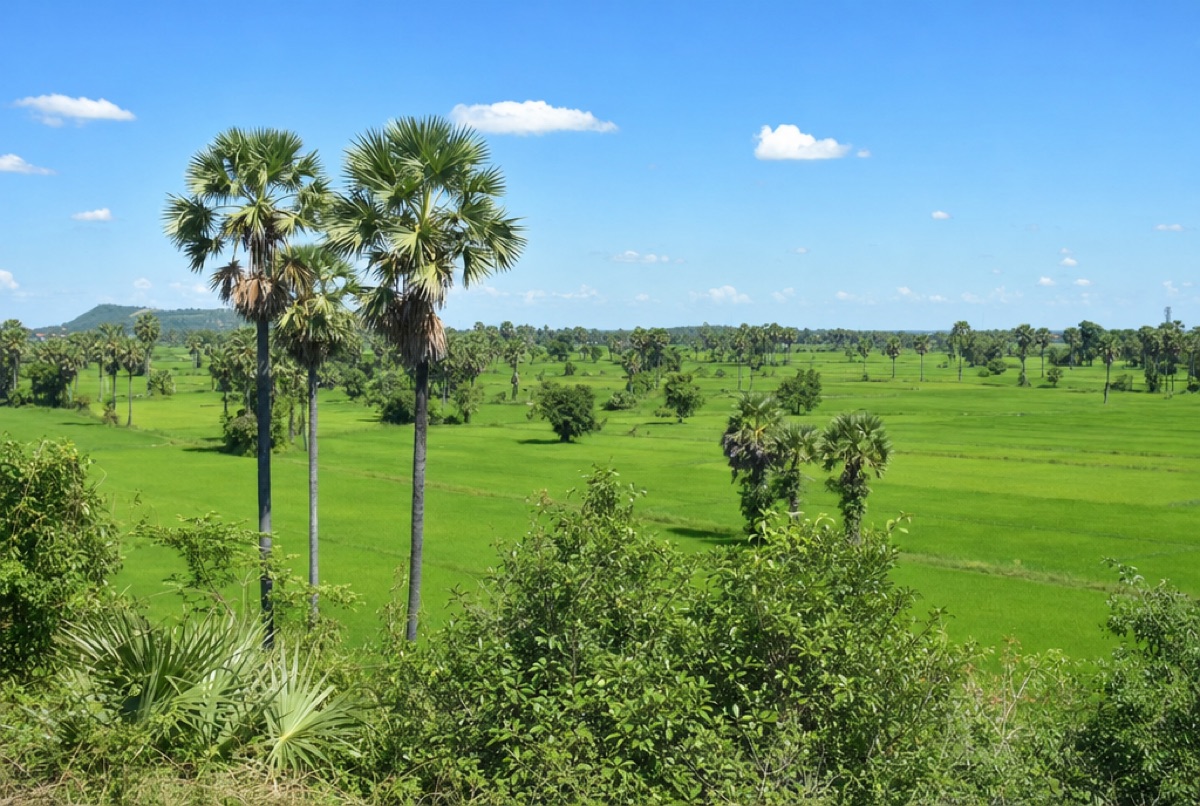
Own productive land. Two sources of value, one clean structure.
Co-own agricultural land in Cambodia's growing provinces. Land value over time, and lease income from an established farm operator. Both shown as area market data, with sources.
Farmland values in the area, published with sources, labeled historical.
Operator lease income.
An established operator leases and farms the land, paying lease income shared among co-owners.
Illustrative concept only, no scale. Area figures publish with sources
on each listing.
How the land is run.
The land and its title are held in the compliant Cambodian
structure and leased to a named operator under agreement. MFC
oversees the operator relationship and reporting.
The agricultural case.
Cambodian farmland sits at the meeting point of three
currents: a government putting real money into agriculture, produce
that wins international premiums, and a world that needs more
food every year. The figures below are historical market and
institutional data, with sources, never a promise of any
co-ownership outcome.
The world's best rice
Cambodian fragrant rice has won the World's Best Rice award seven times between 2012 and 2025, most recently with the Malys Angkor brand of Phka Rumduol (The Rice Trader World Rice Conference). Milled rice exports reached 651,522 tonnes worth 491 million dollars in 2024, over three quarters of it premium fragrant varieties (Cambodia Rice Federation).
7
World's Best Rice titles, 2012-2025 · The Rice Trader World Rice Conference
Kampot pepper and premium produce
Kampot pepper has carried EU protected geographical indication status since 2016 and sold at about 18 dollars per kilogram in 2024, several times the ordinary black pepper benchmark (Phnom Penh Post, quoting the Kampot Pepper Promotion Association). Cambodia's first direct fresh durian shipment to China departed in July 2025, opening another premium export line (Produce Report).
$18
per kg, Kampot black pepper, 2024 · Kampot Pepper Promotion Association via Phnom Penh Post
The king of cashews
Cambodia is the world's second-largest raw cashew producer, known for the oversized M23 'king' kernels that dominate its plantations. Raw cashew exports reached about 1.15 billion dollars in 2024, up 31 percent year on year (Cashew nut Association of Cambodia, via Khmer Times).
$1,150,000,000
raw cashew exports, 2024 · Cashew nut Association of Cambodia
A government behind its farms
In September 2024 the Prime Minister announced a 100 million dollar agricultural financing program through the state Agricultural and Rural Development Bank, alongside a 173 million dollar ADB irrigation project, a 145 million dollar World Bank water-security credit, and an 80 million euro EU package to modernise farming (official announcements, 2024-2025).
$100,000,000
ARDB agriculture program, 2024 · Royal Government of Cambodia via B2B Cambodia
A hungrier world
The FAO projects global demand for food, feed, and biofuel to rise roughly 50 percent from 2012 to 2050 as the world approaches 9.7 billion people, and 295 million people faced acute food insecurity in 2024 (FAO; UN DESA; Global Report on Food Crises 2025). Productive land close to Asia's growth is the supply side of that arithmetic.
50%
projected food demand growth, 2012-2050 · FAO, The Future of Food and Agriculture
Agriculture in the economy
Agriculture contributed 16.7 percent of Cambodian GDP in 2024, with agricultural exports of 5.2 billion dollars and a national push into agro-processing (Ministry of Agriculture, Forestry and Fisheries statements).
$5,200,000,000
agricultural exports, 2024 · MAFF via Construction & Property News
District and market figures are historical data shown for context. They
are not a forecast or a promise of return on any co-ownership interest.
The land.
TESSAIC · Battambang Province
Opening soon
Sangke Rice & Cassava Holding
ricecassavamango
District farmland value gains, 5-year
N/A
Operator lease income, area (annual)
N/A
Land area
N/A
Fraction size from
1/12 of registered interest
Fraction price from
N/A
Operated by
N/A
District and market figures are historical data shown for context. They
are not a forecast or a promise of return on any co-ownership interest.